Range Repair
Viking Maintenance Calendar: What to Clean Weekly to Yearly
Viking maintenance is a short calendar: rinse the dishwasher filters weekly, wash refrigerator door gaskets every three months and clear the condenser about every six months. This guide lists each task, the safe way to do it and what a technician adds.
Renata Duval
- Role
- Service technician — dishwashers and water systems
- In the trade
- 16 years
Tests fill and drain as one loop rather than as two separate parts. Most complaints that arrive as "it stopped cleaning" turn out to be water volume or a restricted return, not a failed pump.
Viking maintenance takes about ten minutes a week plus a longer session a few times a year: rinse the dishwasher filters weekly, soak grates and check burner ports whenever spills bake on, wash the refrigerator door gaskets every three months, and clear the condenser roughly every six months. Those habits head off the calls we see most often on Viking appliances, from lazy burner flames to a fridge that drifts warm. In Los Angeles the routine earns its keep, because hard tap water leaves scale in dishwashers and ice makers, and summer afternoons in Studio City and Sherman Oaks push a refrigerator condenser harder than a mild coastal kitchen would.
Your Viking care calendar
| How often | Appliance | Task |
|---|---|---|
| Weekly | Dishwasher | Lift out and rinse the filter set |
| After spills, or monthly | Range or rangetop | Soak grates, inspect burner ports and caps |
| Every 3 months | Refrigerator | Wash and condition the door gaskets |
| Every 6 months | Refrigerator | Vacuum the condenser on integrated models |
| Every 6 to 12 months | Refrigerator | Swap the water filter, by model |
| Once a year | Everything | Professional check of gas, seals and controls |
Range and rangetop: burners, grates and griddle
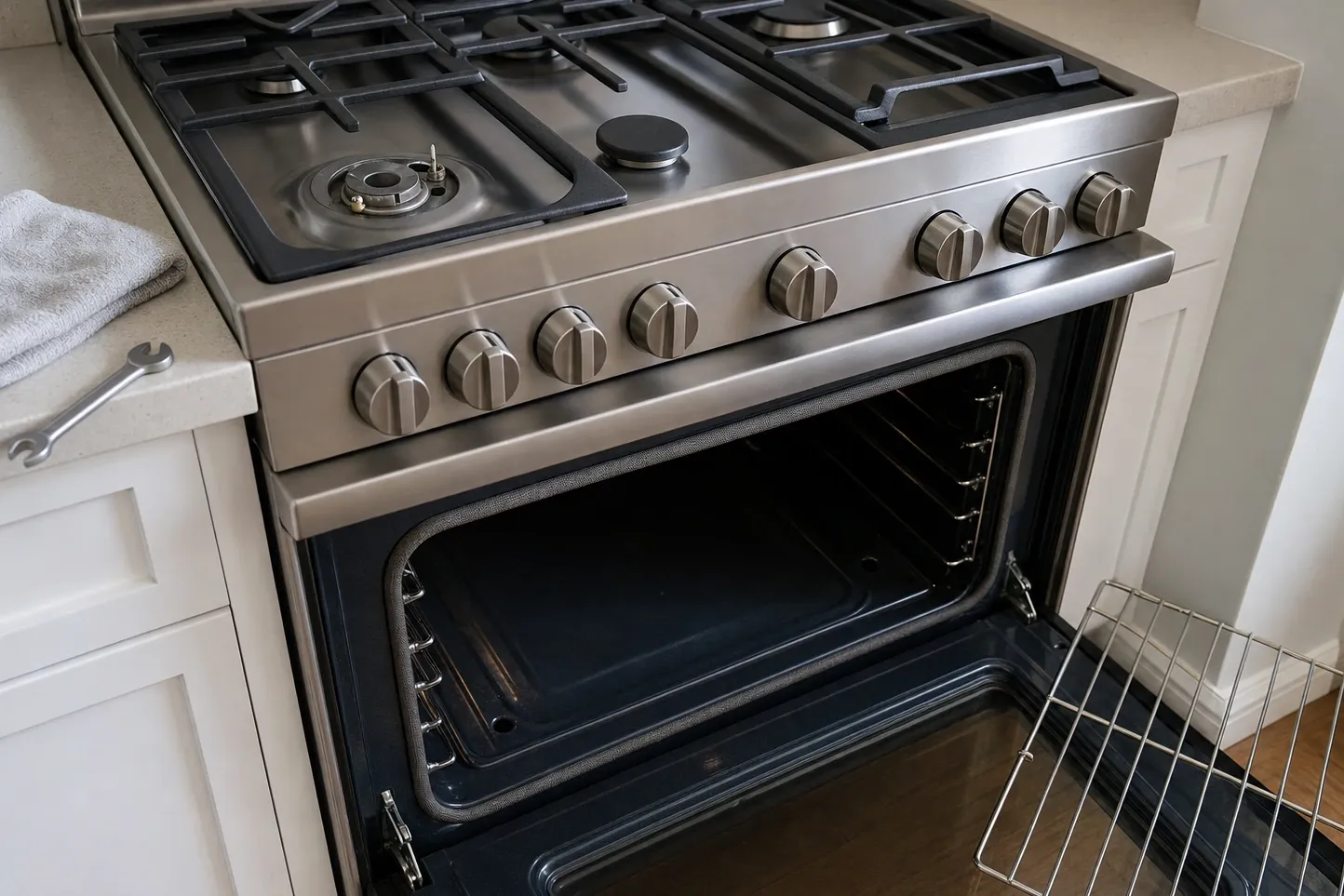
Grates take the most punishment. Viking suggests soaking them in hot, soapy water for 15–20 minutes, stirring in a cup of sudsy ammonia when stains refuse to budge, and drying them completely afterward. The final step is a light coat of cooking spray on the bottoms, blotted dry, before the grates go back on.
Burner heads deserve a look whenever a flame burns uneven or yellow at the tips. On 5 Series ranges, open a blocked port with a straight pin. A toothpick can snap off inside, and anything thicker widens the hole and bends the flame pattern. During reassembly, keep the tabs on the burner head away from the igniter, set the cap so it sits level, and turn it until the arrow faces the back of the range. A cap left slightly crooked often keeps the igniter sparking after the burner should have caught.
Owners with a griddle have one more job. A new 5 Series griddle ships with a protective coating that comes off with 1 quart of warm water mixed with 1/4 cup of white vinegar, followed by seasoning with 1/2 to 1 teaspoon of unsalted vegetable oil. 7 Series griddles do not need seasoning at all. After each use, scrape and wipe the plate once it is cool enough to touch so grease never hardens into a crust.
Refrigerator: condenser, gaskets and water filter
The condenser is where a built-in refrigerator dumps its heat, and a dusty coil makes the compressor run longer to hold temperature. Care depends on the model. Viking 5 Series built-ins carry a Super Clog-Resistant pin-and-tube condenser meant to run without routine cleaning; if dust does build up, an extended narrow vacuum attachment will reach it.
Integrated models nag you themselves. A 7 Series integrated unit blinks CL in the temperature display when its coil is due, and Viking recommends a cleaning every 6 months; hold the up and down arrows for 3 seconds to clear it. FDREIC, FDFZIC and FDBMIC7360 units flash CHECK COND. on the same six-month rhythm. Switch the unit off by holding its power key for about 3 seconds, give it about 30 minutes, remove the grille beneath the door, go over the coil with a soft brush and vacuum, then power it back up and reset the reminder.
Door gaskets get washed every three months with mild detergent, or with 4 tablespoons of baking soda dissolved in a quart of warm water. Finish by rubbing a thin film of petroleum jelly into the rubber so it stays flexible. ENERGY STAR advises replacing any seal that is no longer airtight; to test, shut the door on a strip of paper and feel whether it drags as you slide it out.
Filters differ more than most owners expect. The RVFFR336 French-door uses RWFRVFFR and wants a fresh one every 6 months, after which you hold Alarm Off for 3 seconds to clear the icon. 7 Series integrated units take RWFDISP, which twists out a quarter turn counterclockwise from the lower right corner behind the door; press the lit FILTER button once the new cartridge is seated. An overdue filter starves the ice maker of water, so change it before deciding the freezer has stopped making ice for good.
Dishwasher: filters and LA hard water
On a 5 Series Viking dishwasher, food is caught by a three-piece filter that the manual says to clean at least once a week. Turn the micro and coarse filter assembly counterclockwise and lift it out, pull the flat filter free, brush all three pieces under the tap, then put them back and turn until they click. Neglecting this is how a dishwasher starts leaving grit on the top rack or draining slowly.
Hard water adds a second chore. Mineral film coats spray arms and the tub over time, so keep the rinse-aid dispenser topped up and run an empty cycle with a dishwasher descaler every month or two. Our answer on whether Los Angeles hard water hurts a Viking dishwasher walks through the warning signs.
Oven: habits that protect the controls
Oven upkeep is mostly about what to avoid. Wipe the door gasket with a damp cloth rather than scrubbing it, because a torn or flattened seal leaks heat and skews the temperature. Keep foil off the oven floor, where it traps heat against the lower element and disturbs airflow. On convection models, listen for a fan that scrapes or stays silent during a convection bake. If preheating starts taking noticeably longer than it used to, a bake element or temperature sensor may be weakening.
What a professional tune-up adds
Cleaning is your part. A technician covers what should stay assembled at home: gas connections and burner valves checked for leaks, igniter spark strength, oven temperature measured against a calibrated probe, defrost heaters and drain lines, refrigerant-side performance, and dishwasher pump and door seals. In a Silver Lake or Los Feliz kitchen with more than one Viking, ask whether one visit can cover two appliances so a yearly check takes a single morning.
When upkeep turns into a repair
Cleaning cannot replace worn parts. Book a visit if a burner still refuses to light with its cap seated correctly, if the fridge stays warm with a clean condenser, or if water still pools in the dishwasher after the filters are clean. A single $89 call covers the trip and the diagnosis, and that sum is credited against the work when you approve it. Typical ranges run $180–$460 for an igniter or burner assembly, $290–$660 for a refrigeration fan or defrost problem and $210–$380 for a dishwasher pump or control, with the firm figure given after diagnosis as described in how a repair quote is approved. Call (213) 320-7007 to set up a visit.
Asked after this one
- When is a Viking built-in fridge due for a condenser cleaning?
- Plan on every six months for integrated models. A 7 Series integrated unit tells you by blinking CL in its temperature display, and FDREIC, FDFZIC and FDBMIC7360 units show CHECK COND. on the same schedule. The 5 Series built-ins use a pin-and-tube condenser that normally needs nothing, though a quick vacuum helps if dust gathers on it.
- How often does a Viking refrigerator water filter need changing?
- Anywhere from six to twelve months, depending on the model, so read the label inside the door before ordering. The RVFFR336 French-door takes RWFRVFFR every 6 months, older F20413 built-ins such as the VCSB423 and VCBB363 want a new cartridge every nine months or 750 gallons, and FDREIC, FDFZIC and FDBMIC7360 units allow up to 12 months.
- Can I use a hair dryer to defrost the freezer faster?
- No. USDA food-safety guidance warns against any electric heater, ice pick, knife or other sharp tool for removing frost, because each can damage the inner liner. Let the ice melt with the door open and towels underneath, and book a check if heavy frost keeps coming back, since that usually points to a defrost fault rather than a cleaning job.
- My Viking igniter does not click at all. Is that a maintenance issue?
- Sometimes it is. If no burner clicks, confirm the range is plugged in and its breaker is on, because the spark module runs on household current even though the burners burn gas. If just one knob is silent, a boil-over may have soaked its switch; let it dry for a day before trying again, and call if it stays quiet.
- What does a Viking service visit cost?
- The visit costs a single $89, which pays for the drive and the diagnosis and is subtracted from the bill once you approve the repair. Common fixes fall in typical ranges, such as $180–$460 for an igniter or burner assembly, and the firm price comes only after the technician has located the fault.